Carmak
-
Posts
714 -
Joined
-
Last visited
Content Type
Profiles
Forums
Events
Gallery
Everything posted by Carmak
-
1972 Challenger parts needed!
Carmak replied to usmc_vette1984's topic in Model Building Questions and Answers
My advice is to watch E-bay and buy a nice built original MPC 72 Challenger ($60-$80) and rebuild it. It will require patience to find one, but the results will actually look like a Challenger. As for the Cuda the MPC 74 Easy Build kit is essentially an unassembled promo. If you are comfortable with removing the massive bumper guards from the 74 bumpers you can convert it to a 72. Watch out for the 74 Cuda Pro Street kits, they were issued in the 80's/90's and have a pro street chassis with large wheel tubs (probably not what you are looking for). -
Kits manufacturers from the 60’s and early 70’s had very distinct personalities and styles. Each had pros and cons to their style of kit. Below are my general OPINIONS of each of the big manufacturers of 1:24/1:25 scale American car kits during the first golden era which ended in the mid 70’s. There are exceptions to everything I say below. These are my general OPINIONS. Revell. Pros: Kits with many functional features with good detail. Kits of actual show cars and competition cars. Cons: Cars were not their only kit type. Challenging to build with very fragile parts (early multi-piece bodies). Late 60’s into early 70’s kits design quality decreased. Monogram. Pros: Easy to assembly kits. Best molded in color kits ever made. Tom Daniels kits. Their “Classics” kits built well and look good. Con: Cars were not their only kit type. Inconsistent scale choices. Poor proportions on some kits. AMT / SMP. Pros: Promo based business model allowed for a very wide range of fairly well-proportioned annuals each year loaded with custom and race parts (3in1 kits). Most trophy kits were good subject matter and straight forward to build. Cons: Promo based chassis and interiors on most annuals. Late 60’s into early 70’s kits design quality decreased (poorly modified re-issues). MPC. Pros. Promo based business model allowed for a wide range of fairly well-proportioned annuals each year loaded with custom and race parts. MPC non-annual kits were good subject matter and straight forward to build. Stock bodied Funny Cars are either a Pro or a Con depending on the point of view 😊. Con: Promo based chassis and interiors on most annuals. 70’s kits design quality decreased (poorly modified re-issues). JoHan. Pros: Promo based business model allowed for a decent range of the best proportioned body annuals each year loaded with custom and race parts. Their “Gold Cup” kits were well proportioned and second to none for functional features. Con: Promo based chassis and interiors on most annuals. Slowly withered in the early 70’s with few new kits.
-
In the full size Pontiac world there is a well know LOADED 65 2+2 convertible painted Cadillac Samoan Bronze. In this case it was a Brass Hat car but it was still given a factory custom paint.
-
It is a rear door so you load it then very very carefully move it.
-
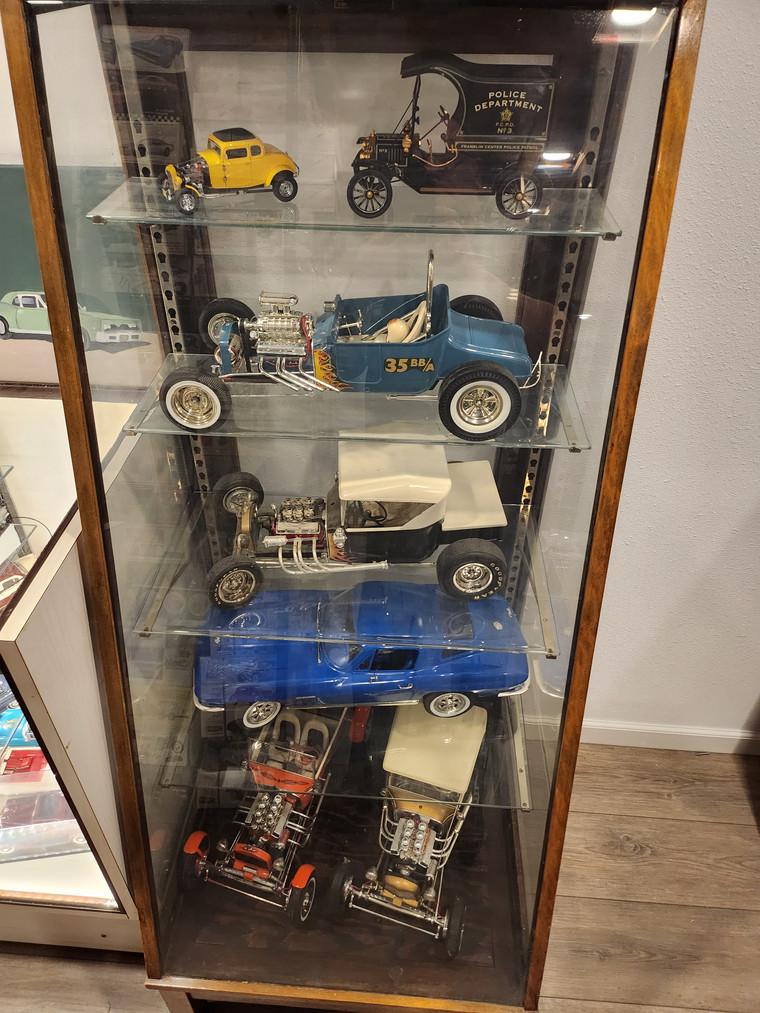
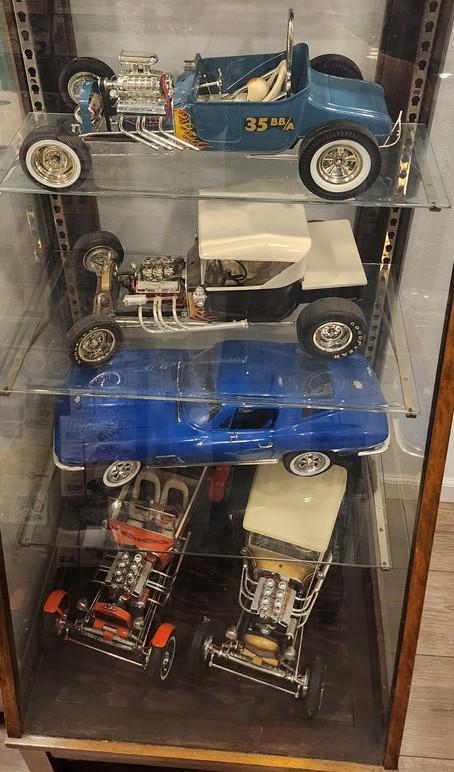
Space was an issue with me. In the early 90's I got a 70's? issue Big T that was on display at my local hobby when I was a kid. I stored it for years. About 3 years ago I found the perfect 1/8 scale display case and put the Big T in it. A month later I locally stumbled onto nice survivor Big Rod, Big Tub, Big Drag and a 65 Vette. All I need now is the pedestal for the display engine.

-
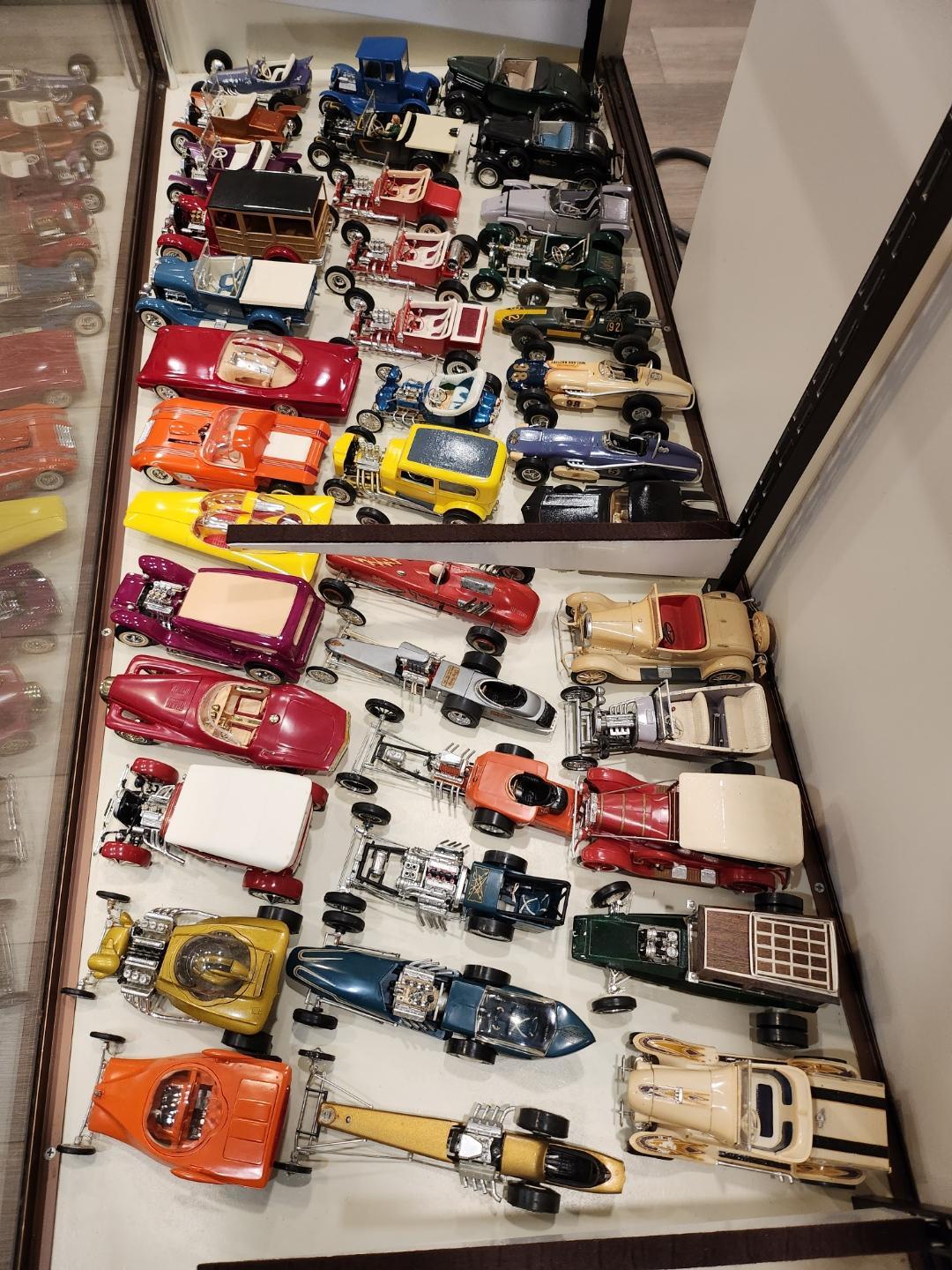
I was born in the late 60's and I saw the very end of the first golden era of model cars. As a 60's car nut I remember being frustrated as a kid that I missed out on all the cool models. I trolled yard sales and flea markets in the late 70's thru the mid 80's looking for 50's and 60's era kits. My hoarding stems from this early experience that what is available today may be gone tomorrow. My stash exceeds 2,000 kits (a couple hundred pre-1975) and 1,000 pre-1975 re-builder projects (with a couple hundred "donor" kits for the re-builders). I'll never do them all. I am okay with that
-
Last night I compared a Hasegawa 65 to an AMT 65. the wheelbase looks to be the same. I did a quick bumper check, and the Hasegawa parts are a little narrower than the AMT parts and the pocket for the grille is shaped a little different. The Hasegawa body is definitely 1/25 scale.
-
Here are some pics of the slot car in its original form. The body was copied from an AMT promo back in the day so the proportions are actually okay. The chassis and interior were designed years later (after the slot car boom went bust) and they are super generic and kinda suck. Having said that, I have one .
-
The color "Mink Silver" was a special color in 68. A good friend of mine had a Mink Silver 68 with Black Buckets with a floor shift that he bought in 68 as a 6 month old used car (the original owner bought the car specifically to take a large cross county road trip).
-
Corvairs Through the Darien Gap
Carmak replied to Falcon Ranchero's topic in General Automotive Talk (Trucks and Cars)
Years ago, I drove a friend's 66 Corsa 140 (4 carb) 4spd. It was a glorious machine, like driving a full size go cart! In the 90's and early 2000's I parted out cars as a side hustle. I had friends that were scrapers, and they would call whenever they got anything mid 70's or older. Early on one of those cars intercepted on the way to the crusher was a 66 Corvair 4dr with the 140, 4spd and a telescopic column. It was Iowa rusty and on the edge of losing structural integrity, but the engine turned over and I don't think it had been taken off the road much before I got it. What a cool 4dr that must have been when new!! I sold it to a local Corvair guy as a parts car so he could upgrade his more standard 65 coupe (he really wanted that improved 66 4spd trans). -
Corvairs Through the Darien Gap
Carmak replied to Falcon Ranchero's topic in General Automotive Talk (Trucks and Cars)
First off, not a Nader fan, but..... I read "Unsafe at Any Speed" years ago. The book does not focus on the Corvair in particular. Where the book does discuss the Corvair it explains and shows how the 65 rear suspension resolves the issues with the 60-64 rear suspension. The reason everybody knows Nader - the book - it's connection to the Corvair is GM. They attempted hired a group of people to attempt to ensnare Nader with a young woman to smear his reputation. It blew up on GM and became front page national news. GM's attempt to smear Nader actually got him the publicity the books release did not. Nader didn't kil the Corvair, the Mustang did. When GM released the F-body cars (Camaro/Firebird) to compete with the Mustang there was no need for two sporty coupes. GM made Corvairs until 69 but effectively stopped development after 67. -
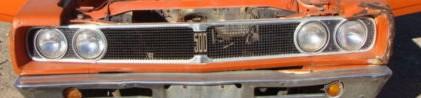
I also plan to build a Coronet 500 using the R/T kit. The 1:1 68 Coronet has stamped aluminum headlight bezes with the mesh area in the bezels as raised ribs. The center grille is a thin aluminum eggcrate. I am going to cut the center out of the kit grille and replace it with a fine mesh (I have to find one). Remember - unless your Coronet 500 or R/T was a dark color the radiator support was painted black so you could not see body color thru the grille.
-
The AMT Craftsman kits do not have engines. They are "curbside" style kits as are many European and Japanese kits. The AMT "Craftsman" kit type dates to the 60's when AMT would sell unassembled promo cars (typically molded in color) as an entry level kit for younger builders. The modern Craftsman kit are designed to accept an engine if the builder chooses as they have a separate engine plate, the hood opens, they have a firewall and radiator support detail. In the future these kits may be issued with engines. The 63 Nova wagon was initially issued as a Craftsman and later issued with an engine and other parts (trailer with a separate engine). Craftsman kits also work well with the trend of using 3D printed engines. Hope this helps. Carmak
-
GENERAL LEE general question
Carmak replied to Brutalform's topic in Model Building Questions and Answers
I will speak to two different versions of (MPC/AMT/ERTL) plastic model kits. The first version of the General Lee was made by combining pieces of a Daytona stock car kit, original 69 tooling and some 71-72 Charger tooling. The body had the Daytona flush rear window, It didn't have and taillight bezels, the grille inserts were 71-72 Charger, nothing fit really well, and the tooling was worn. It then became the best-selling model car kit of all time. The second version was revision of the first version. The rear window was fixed. The tail light bezels were sorta molded into the body. It got a little better in some places but the tooling was even more worn and nothing fit. I grew up building these kits (multiples) and I loved them. An okay model can be built using either of these kits (not accurate, just okay) if you put some work into it. If I wanted to build a nice, detailed replica I would use the Revell kits. -
Johan Superbird - Sox Martin version
Carmak replied to gtx6970's topic in Model Building Questions and Answers
Thanks Bill! I also noticed the NASCAR kit was much more common than the SM kit in the 80's (I didn't see my first SM kit until I went to a major Chicago area swap meet in the mid 80's). Maybe they only ran it when they could get white styrene -
Johan Superbird - Sox Martin version
Carmak replied to gtx6970's topic in Model Building Questions and Answers
When was the first issue of the NASCAR version? Was the NASCAR version available concurrent with the SM kit in the 70's or 80's? -
So everything new is mo better, huh?
Carmak replied to Ace-Garageguy's topic in General Automotive Talk (Trucks and Cars)
I design medical devices (30+ years). As you might imagine my industry is highly regulated (we sell around the world, so we comply with multiple sets of regulations). The high level result of these regulations are: The good: Our products are safe and work as intended at a very high percentage. By law only properly trained individuals can use our products. The bad: The cost of the rigorous testing is included in the cost of our products and the regulations can limit innovation. The aftermarket auto parts industry is nearly the opposite. Sure there are some voluntary industry standard groups, but they pale when compared to the medical requirements. In the absence of any regulation the free market will tend to drive the cost down to the point where everything is garbage. As a car guy I am not a fan of regulation but currently the pendulum may have swung a little too far. -
Parts comparison needed, please.......
Carmak replied to JollySipper's topic in Model Building Questions and Answers
There have recently been a couple discussions interchangeably for bumpers between the AMT 71 and the MPC 71-74 Chargers. One of those recent discussions included pics of bumper test fits. You should search "Super Charger". The short answer is they don't fit correctly. An option would be to cut the grilles out of the 73/74 grille and put them in the 71 Bumper. Same concept should work on the rear bumper. Hope this helps -
Well over a decade ago I bought a Page resin at a swap meet in Northern Illinois (I think he lived in that area at that time). It was a 61 or 62 Cadillac 2drHT. It was a nice casting with good proportions. I thought I heard he relocated to the Minneapolis area a few years ago. Hope this helps.
-
I am with Alan Barton and Les on this as well and for the same reasons. I'm glad you are finishing it "as is". I have a small display of kits I built in grade school and Jr. High. It is a nice reminder that we all start somewhere.
-
There is a FB group called "Scale Survivors" that is focused on plastic model car kits built during the first golden era (before 1980) that have survived in their original built form. I have been collecting survivor builds for decades. Most of my survivors were found locally by word of mouth. The majority of my survivors were acquired from the original builders or their heir. I really like the charm and nostalgia of a vintage kit built when new (often by a teen or young adult).
-
65 Comet station wagon
Carmak replied to chris chabre's topic in Model Building Questions and Answers
Hypothetically, if someone was going to make a 65 Falcon or Comet wagon would the 61 Ranchero be the correct windshield size to start with? -
MPC Super Charger - 1974 Charger rundown
Carmak replied to CapSat 6's topic in Car Kit News & Reviews
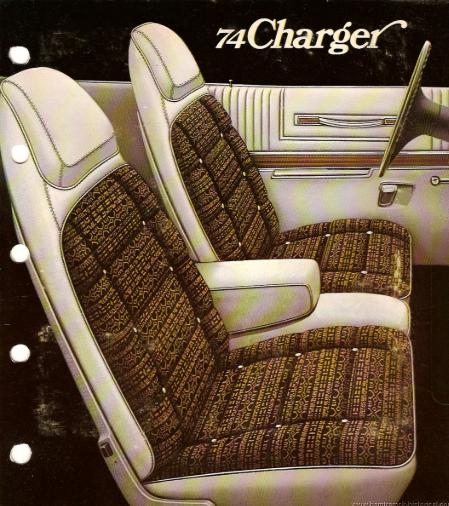
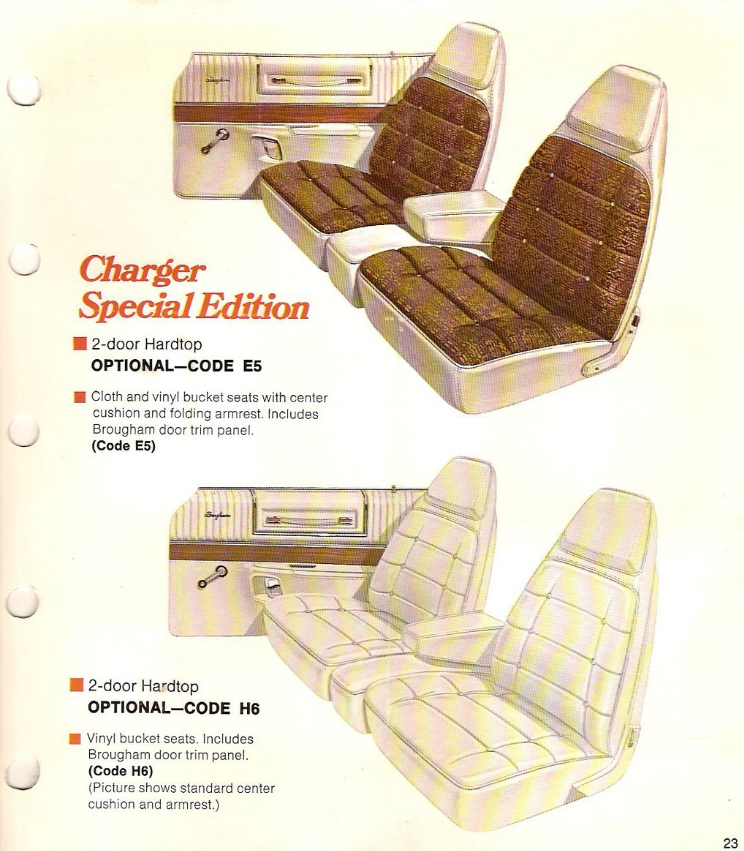
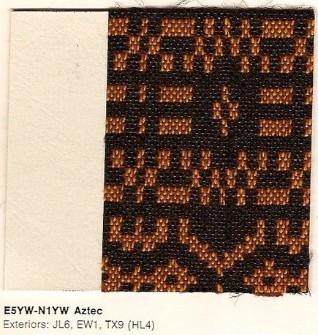
I looked into the original 1974 Dodge Charger Color and Trim Book pages to see if either of the upholstery designs used in 74 were correct. I discovered this funky cloth insert was available in 74 on the buckets. This is definitely going to find its way into a build!
-
MPC Super Charger - 1974 Charger rundown
Carmak replied to CapSat 6's topic in Car Kit News & Reviews
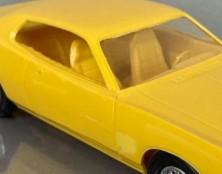
This is really interesting Steve. What jumps out to me about your buckets is the center button with center pleat. This COULD explain the softer headrest detail - maybe??? I just looked up the upholstery pattern in 1:1 Dodge Chargers in 74 and there is no center button/pleat (it is unchanged from 73). It is possible that Dodge had INTENDED to change the pattern in 74 but the change did not make it to production. MPC may have run some promos and kits with the proposed pattern and then corrected it to remove the center button/pleat. The only 74 promo I could find a pic of that clearly shows the seats (see pic) does not have the center button/pleat.
-
MPC Super Charger - 1974 Charger rundown
Carmak replied to CapSat 6's topic in Car Kit News & Reviews
Some more observations and comparisons of 72-74 annual bodies and interiors plus the 72 NASCAR Baker body and the early 73 NASCAR Petty body and hood. All bodies look to have the same trunk emblems. Both 72 bodies have the same C-pilar emblem with no rocker trim, both 73 bodies have the same door emblem with ribbed rocker trim and the 74 door is very slightly changed from 73 but with the same rocker trim. Both 73 hoods look the same except for the hood pins on the Petty hood. All interiors look to the same basic upholstery patterns, but the headrest shape are looks to have changed in 74 (and the Super Charger). The Petty Charger body has the posts blocked off but still has the station wagon cut line that the 73 and 74 annuals have.